
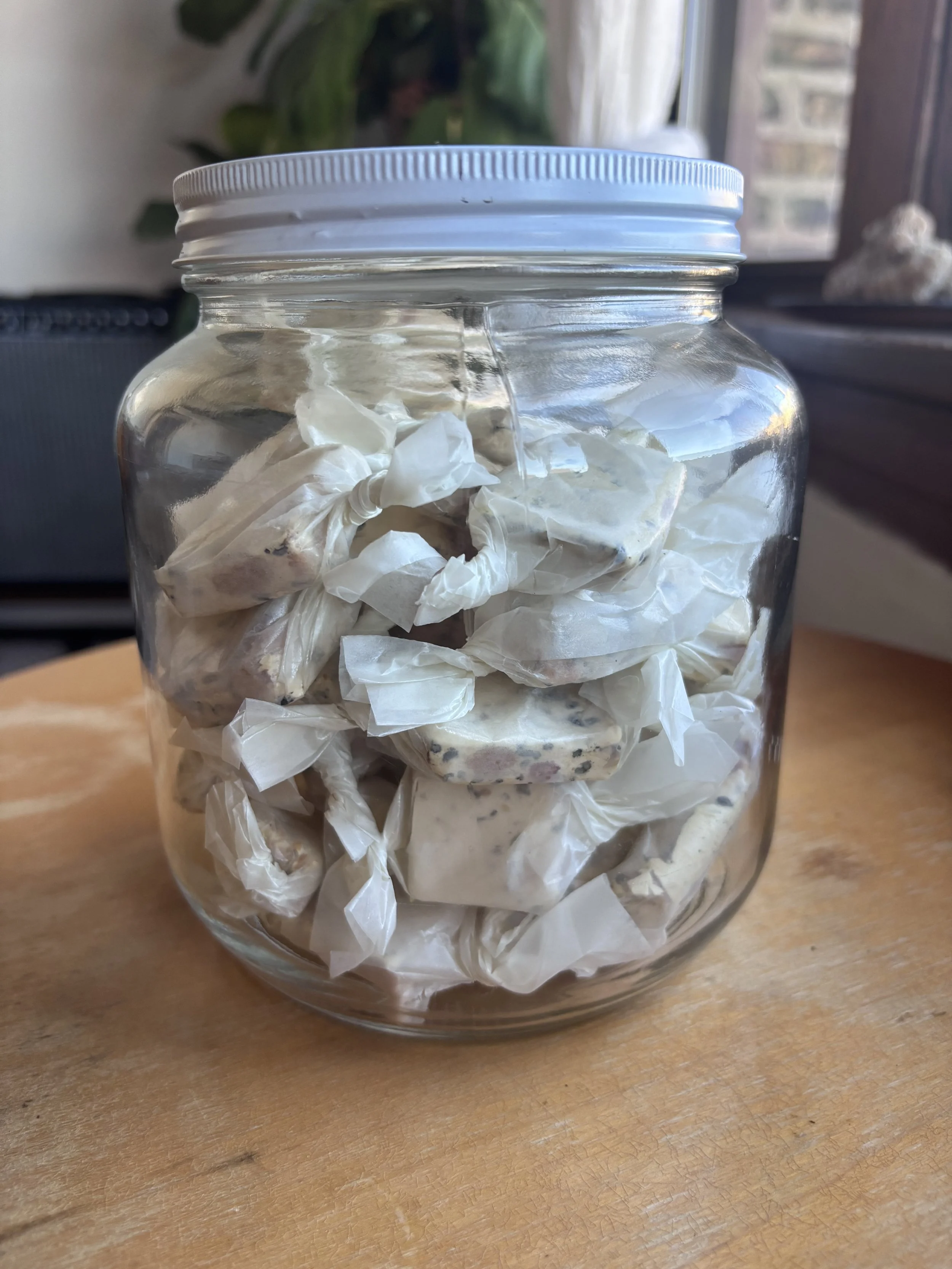
When it comes to making candy and confections, there’s just no substitute for experience. That’s something I have learned the hard way, as I watched batches of carefully researched and finely planned candies crash and burn across many attempts.
For home cooks like myself who are products of the online recipe world, weaned on cooking shows, YouTube chefs, and an infinite supply of recipe blogs, baking (and cooking) can seem like nothing more than a series of steps to follow. Measure, combine, mix, bake, and bask in the wonder and adoration of friends and family who are blown away by your incredible creations.
But I, at least, quickly learned that it’s not so simple. Through broken laminations, burned caramels and I don’t even want to know how much money wasted on ingredients, I came to understand why pastry chefs are more like tradespeople than creative masterminds. The secret to great candies and baked goods isn’t a brilliant creative approach or a well-stocked pantry (and the funds to restock it). It is, simply, the persistence to practice, and the willingness to set your ego aside and let techniques develop over time.
That’s the approach I took when I decided to make Nougat Montélimar on a Sunday morning.
What the heck is nougat?
Like (I suspect) many Americans, I spent much of my life only knowing nougat (or noo-gah) as noo-get, the mysterious tan stuff you find in a Milky Way or other candy bar, and not a candy unto itself. Once I began experimenting with baking and confectionery, and exploring specialty shops and makers, nougat was one of the first things I resolved to add to my repertoire. But it was also too intimidating to even try.
It requires ingredients I didn’t typically keep on hand, techniques I’d never tried, and supplies I’d have to special order. All to make something no one had heard of or even understood. So it was years of baking, reading and learning before I found the courage to even try.
The best laid plans…
I recently got a copy of Peter Greweling’s Chocolates & Confections, an encyclopedic and authoritative guide to techniques and recipes for a vast array of candies. I’m still working through the text, which offers an approachable blend of food science and practical direction, but the first set of recipes I dug into was the nougats.
In the age of digital access, it’s easy to overanalyze a project like this. There are recipes to read, explainers to understand, videos to watch, versions to consider, each just different enough to make a curious reader more confused and uncertain. That’s one of the reasons I went to a book instead of the internet. Unfortunately, my vision was more complete than my pantry.
I was set on making the recipe that morning. But lacking a few key but specialized ingredients, things like dried egg whites that I couldn’t readily find in any local stores, I couldn’t tackle Greweling’s recipe as written, and given the precise requirements of the technique, I also didn’t want to start making substitutions. And I wasn’t ready to give up on my plan so quickly.
Luckily I came across this Culinary Institute of America (CIA) recipe for Nougat Montélimar. Greweling is a longtime CIA instructor, so I felt I was on solid ground with this alternative. And this version only used ingredients I could easily find with a trip to the store. The ingredients were straightforward, and the recipe only has 5 steps. Simple, right? Yes and no.
I’ve recently been making caramels, both for caramel apples and as individual candies, so much of this felt familiar. But despite the apparent simplicity of the recipe, the reality was much more complicated. Let’s look at a few of the challenges I faced, my solutions, and then a few takeaways.
Here’s where things go wrong
To start, the first step of the recipe calls to heat the syrup to 306°F (152°C), then beat the egg whites while the syrup continues on to 316°F (158°C). My assumption, picked up from half-remembered recipes and random cooking videos, was that this second stage would take awhile. I was wrong. My syrup quickly shot to ~324ºF in the few moments I had looked away to beat the egg whites.
The color was now dark, and verging on black. I’ve burned enough caramel to know that there is a point of no return, where the bitter, acrid flavor cannot be redeemed. And after hours of shopping, chopping, toasting and prepping, I was not ready to accept that I had ruined the syrup. So I decided to just use it anyway.
Next came the pouring. Pouring a thin stream of super-heated syrup into a running mixer, without hitting the whisk, is both simple and very difficult. So unsurprisingly I was left with bits of hardened spray across the top of the mixer bowl. But the base came together, with a cream color that was not as ivory-white as traditional nougat but still quite appealing.
What did not come together was the adding of melted cocoa butter. For no good reason, I did not follow the recipe's instruction to fold in the cocoa butter, instead opting to add it with my mixer’s paddle. The result was globs of nougat base slipping around inside pools of cocoa butter. I let it mix longer, I pressed it with a spatula, I brought back the whisk in hopes of forcing them to emulsify, none of which worked.
At this point, I was tired, frustrated, and ready to dump the whole batch. My last-ditch effort was to place the entire mixer bowl over a pot of simmering water, or a bain-marie, hoping that softening the base would help bring the batch back together.
And after a few minutes of folding and pressing, I was delighted to find that it did. Suddenly I had a pillowy poof of cohesive nougat, with just small amounts of residual cocoa butter not making its way inside. At this point I was well off recipe, so all I could do was watch closely and use what little judgment I had available to me. After another few minutes I realized the remaining cocoa butter was not absorbing, and that continued heating was once again separating my nougat.
So at this point I stopped the heat, poured off the last bit of cocoa butter, and separated my batch into two bowls. I had made a version of the original recipe’s traditional inclusions, but I also made a second batch inspired by the black sesame nougat at Sugoi. For all the effort it took to prep for this recipe, I wanted to experiment in as many ways as I could without overcommitting to one direction. Splitting the inclusions gave me two ways to explore flavors and see how they worked (and tasted).
With a gloved hand, I mixed the batches and poured them onto lightly oiled parchment on two sheet pans, and rolled them flat with a pin. After about 4 hours and a healthy amount of anxiety, I had two batches of actual nougat. It looked like it was supposed to, tasted like the real thing, and taught me more about confectionery than I could have learned in twice as long spent reading recipes.
And that is the most valuable outcome of this entire process. The candies are great, much better than I expected given the challenges I faced along the way. But to be honest, I care less about the candy than I did the experience. This was about taking on a challenge, persisting through obstacles, and seeing it through to the end. It challenged my creativity, my willpower, and my focus. And if I get a few jars of excellent snacks along the way, so much the better.
Making nougat may not be for you. If you aren’t interested in a huge quantity of very specific candies, you may never try these recipes. That’s fine. I’m not here to tell you to go make nougat. But I am here to tell you to try and make something that’s a little scary, a recipe that pushes you out of your comfort zone and requires you to learn along the way. Whatever the result, the sweetest part is savoring your own success.
Recipe: Nougat Montélimar
This is my rewritten variation on the CIA recipe. The core amounts and techniques are unchanged, I simply modified it based on my split and my own recipe-reading preferences.
Note: I used a hand mixer for the egg whites, as I find that the whisk attachment doesn’t work well with small amounts of egg white in my 6qt mixer bowl.
Nougat base, full batch
Granulated sugar: 369 g
Water: 99 g
Honey: 227 g
Vanilla bean: ½ bean
Egg whites: 50 g
Sugar, for egg whites: 28 g
Cocoa butter, melted: 99 g
Inclusions
The two inclusions match up with the total weight called for by the CIA recipe, just split based on what I had on hand and my own preferences.
Traditional
Whole blanched almonds: 99 g
Hazelnuts: 35.5 g
Roasted pistachios: 35.5 g
Sliced almonds: 36 g
Dried mango: 24 g
Dried apricots: 24 g
Currants: 23 g
Total: 277 g
Black Sesame
Whole blanched almonds: 99 g
Walnuts: 52 g
Sliced almonds: 36 g
Goji berries: 50 g
Black sesame: 40 g
Total: 277 g
Step 1: Toast the inclusions
Preheat the oven to 325°F.
Whole almonds: 198 g, approximately 18 minutes
Hazelnuts: 36 g after peeling, approximately 15 minutes
Walnuts: 52 g, approximately 15 minutes
Sliced almonds: 72 g, approximately 10 minutes
Roasted pistachios: 36 g, no additional roasting needed
Black sesame: 40 g, toast in a dry skillet over low heat for 2–4 minutes
Roast the nuts until evenly browned, stirring partway through the bake. I prefer them more deeply roasted so I cook a bit longer, but watch carefully so they don’t burn.
Rub the warm hazelnuts in a towel to remove most skins, then weigh.
Toast the sesame gently in a dry skillet, starting with a cool pan.
Dice the mango and apricots into small pieces. Leave the currants and goji berries whole.
Combine each version's inclusions in separate bowls.
Step 2: Prepare the pans and equipment
Line two quarter-sheet pans with lightly oiled parchment.
Prepare two additional pieces of lightly oiled parchment for shaping.
Have your stand mixer, whisk, hand mixer, and paddle available.
Weigh the 50 g egg whites and separate 28 g sugar.
Melt the 99 g cocoa butter gently and keep it liquid.
Have two sturdy bowls and spatulas ready for dividing the nougat.
Step 3: Cook the sugar syrup
In a heavy-bottomed saucepan, combine:
369 g sugar
99 g water
227 g honey
Seeds from ½ vanilla bean
Bring to a boil, and avoid stirring once boiling. Use a candy thermometer to monitor the temperature.
When the syrup reaches 306°F, start whipping the 50 g egg whites with 28 g sugar until they reach soft peaks. I beat the eggs with a hand mixer directly in the stand mixer bowl.
Watch the syrup carefully until it reaches 316°F.
Step 4: Add the syrup
When the syrup reaches 316°F (158°C), beat the syrup into the whites.
Attach the bowl to your mixer with the whisk fitted.
Run at medium speed.
Carefully pour the syrup into the whipping egg whites in a thin, steady stream, avoiding the whisk.
Continue whipping as the mixture becomes increasingly thick and the machine begins to slow down.
Step 5: Add cocoa butter and divide
Incorporate all 99 g melted cocoa butter into the nougat, mixing only until combined.
Divide the mixture immediately into two roughly equal portions in your prepared bowls.
Fold the traditional inclusions into one portion and the black sesame inclusions into the other.
Step 6: Shape
Transfer each portion to a parchment-lined pan.
Cover with lightly oiled parchment.
Press or roll to ¾ inch thick (or to any even thickness you prefer).
Note that the CIA recipe calls to roll to ¾ inch thick on sugared marble slab. If, like me, you don’t have one, I moved these from the pan and rolled them on a cutting board between the parchment sheets.
Step 7: Cool, cut, and wrap
Let the nougat cool completely.
Cut into desired size with a sharp knife. I cut mine bite-sized for use with small waxed paper caramel wrappers, but many nougats are cut into larger bars.
Store in airtight containers. Freeze the portions you won't eat soon.